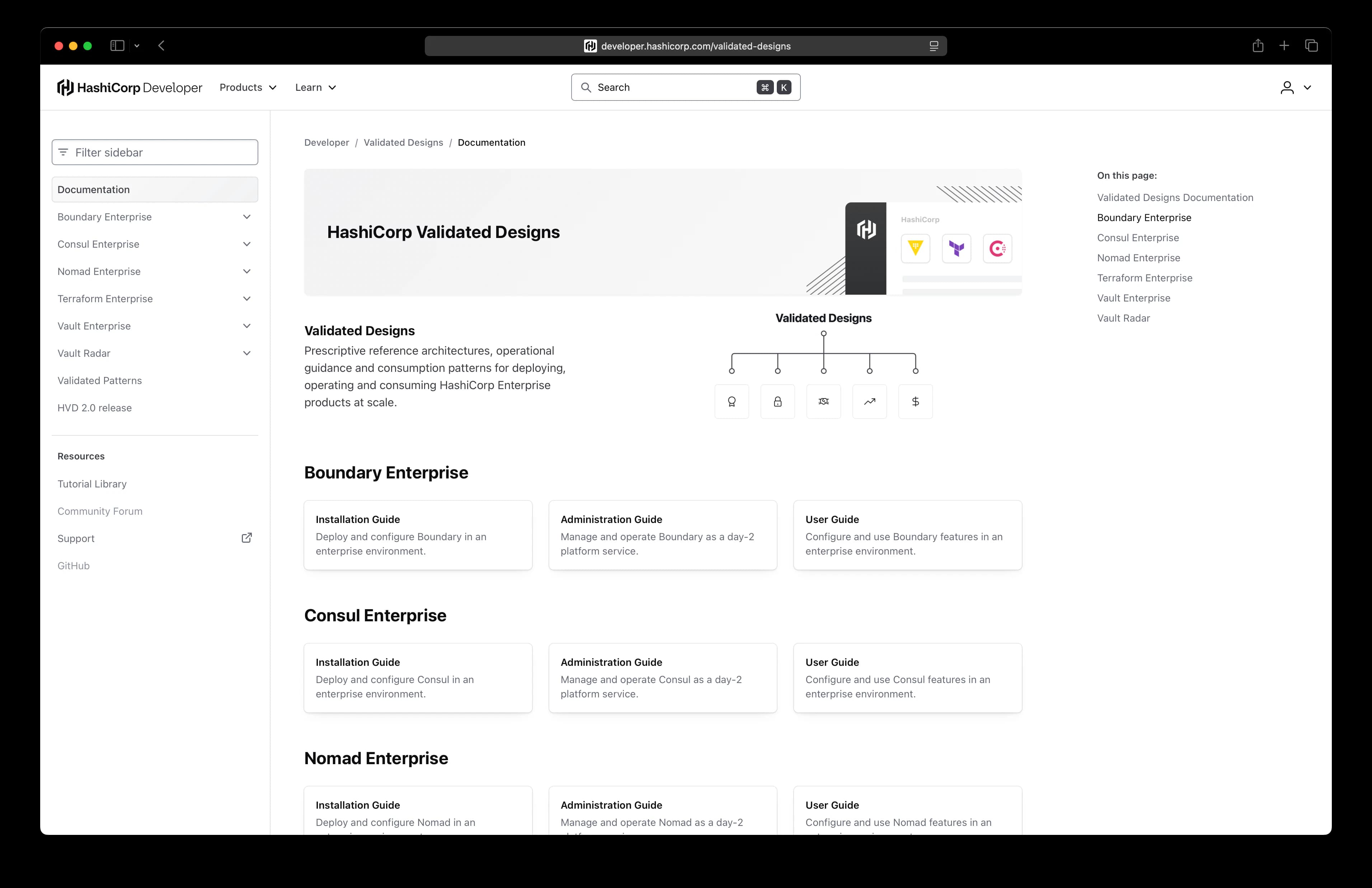

HashiCorp Validated Designs (HVDs) provide prescriptive, enterprise-focused guidance for deploying, operating, and using HashiCorp products in production. They are designed to go beyond feature documentation and general best practices by giving customers an opinionated, end-to-end path for achieving specific outcomes.
This guidance is shaped by thousands of customer engagements across our field organization, including Solutions Engineers and Architects, Professional Services, and Forward Deployed Engineers. HVDs help teams reduce ambiguity, accelerate implementation, and adopt proven operating patterns with more confidence.
Today, we are relaunching HVDs on developer.hashicorp.com with a refreshed structure, a more discoverable home, and a number of usability improvements.
»Why this refresh matters
As our HVD library expanded across products, the content became harder to navigate consistently. Similar topics could appear in different places depending on the product, and readers often had to understand our maturity-model terminology to find the guidance they were looking for.
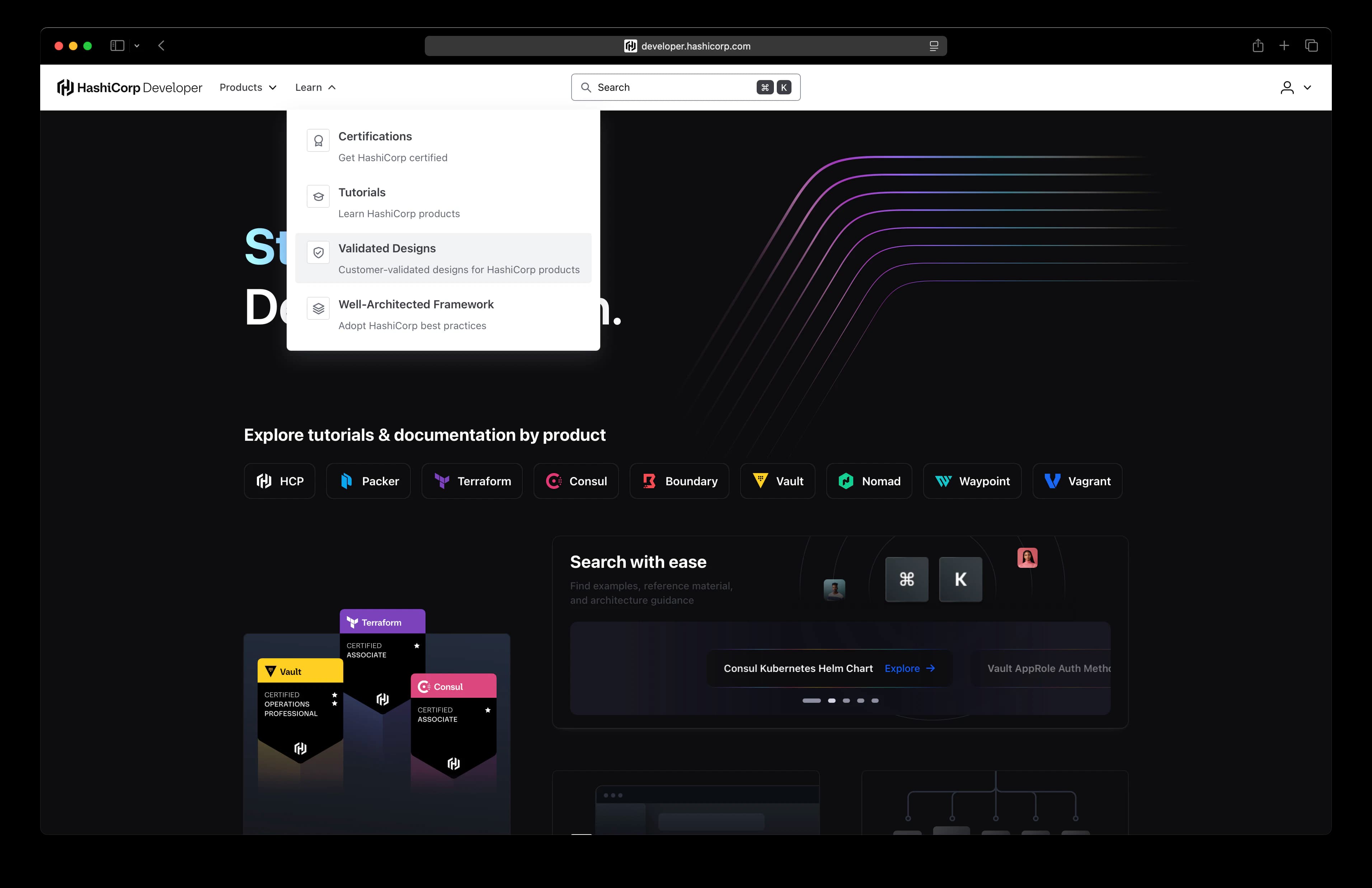
This refresh removes that friction. HVDs are now linked directly from the Learn drop-down navigation and follow a more consistent structure across products. We have reorganized them around the work a reader needs to perform, instead of the cloud maturity stage they are in. That means teams can get to the right kind of guidance faster, whether they are deploying a platform for the first time, managing it in production, or enabling end-user workflows that deliver business value.
»Structural updates
The refreshed structure moves away from the maturity model stages we previously used and organizes product guidance around the product lifecycle, the work being performed, and the teams responsible for it.
»Installation guide
For teams designing and deploying the system. This guidance focuses on infrastructure and system architecture, prerequisites, deployment, post-installation configuration, initial identity integration, observability setup, and other one-time setup tasks required to get a production-ready environment in place. Once system installation and initial configuration is complete, you shouldn't need to use this guide again unless you're deploying additional instances or making significant integration changes.
»Administration guide
For platform and operations teams managing the system day to day. This guidance covers ongoing operational responsibilities such as identity and access management, consumer onboarding, recommended monitoring and alerting configuration, audit logs, backup and restore procedures, disaster recovery operations, upgrades, and support readiness.
»User guide
For platform and application teams using the system to deliver product use cases. This guidance focuses on supported use cases that platform and application teams want to enable with the product, without forcing readers to navigate through operational content that is not relevant to their immediate goal.
This role-aligned structure helps separate one-time deployment work from recurring operational work, and system administration from feature and use-case enablement. In practice, that makes it easier to understand where to start and where to go next.
»Discoverability, indexing and search improvements
One of the biggest changes is discoverability. HVDs now feature in the main navigation, and product documentation, tutorials, and other developer resources can link directly to relevant HVD guidance. This brings several direct benefits for readers:
The developer site search bar now indexes HVD content, allowing easy search across all guides
Public search engines such as Google and Bing can now index HVD pages
Product documentation and tutorials can link directly to HVD content
Validated guidance can now sit more naturally alongside docs, tutorials, and other public technical resources
These improvements matter because customers often begin with a problem to solve, not with a specific document in mind. Better site search, public indexing, and tighter links from product documentation all make it easier to reach validated guidance.
»Learn more in HashiCorp Validated Designs
This update makes HVDs easier to access and use, but the prescriptive guidance remains the same. If you've used these guides before, the content you relied on is still here, but has now moved into the guide that matches the work it supports.
If you are already using HashiCorp products in production or evaluating how to deploy and operate them at scale, HashiCorp Validated Designs are designed to help you find the relevant, field-tested guidance faster and understand where to go next.