


In June, we announced the public preview of native AI agent support in HashiCorp Vault. We are excited to make these new native agentic IAM capabilities generally available in Vault Enterprise 2.1.
These new features enable you to better secure, manage and audit agents across your environments. Enterprises can securely deploy AI workflows and achieve governance over agents. Vault extends its policy-based secrets access and management capabilities to AI agent identities, alongside its existing support for human and non-human identities, so teams can securely scale AI workflows and reduce custom or manual workarounds needed to achieve compliance.
This release also contains significant feature enhancements, including per-request access evaluation, deeper integration with existing OAuth and identity infrastructure and enhanced ability to manage agent identities at scale. Vault users can also now access the Agent Registry in the Vault UI, providing centralized visibility and management for agent identities across the organization.
Together, these capabilities make it easier to deploy agents securely while benefiting from the governance and audibility that teams already use Vault for today. Agentic workflows have been tested and validated with IBM Verify, Auth0, PingFederate, Microsoft Entra, and Okta. These validated workflows reflect Vault's continued investment in meeting security and identity teams where they are by supporting their preferred identity providers and securing both human and non-human identities. Vault now enables organizations to manage agents with the same granular control, security and auditability as with other identities.

Agent Registry in action.
»A new Agent Registry experience in the UI
For teams that prefer working in the UI, GA introduces the Agent Registry in Vault. The registry brings agent identities, authentication activity, policies, and namespace information into a single view, making it easier to understand how agents are being used and what access they have. Agent identities can be viewed and updated directly from the registry, while agent registration and configuration management also remain available through the API, CLI, and Terraform Vault Provider.
»Registering an agent and authenticating to Vault
The Agent Registry is the foundation of agent governance in Vault. Before an agent can use an OAuth credential to access Vault, it must be registered in the Agent Registry and mapped to a Vault Identity entity. Separately, administrators configure an OAuth resource server profile that defines how Vault validates JWTs from a trusted issuer. This establishes a governed identity for each registered agent, which enables Vault users to reduce security, compliance and operational risks when agents request access through Vault, while enforcing least privilege and supporting the lifecycle management of agent registrations.
Once registered, the agent authenticates with its identity provider and receives a signed OAuth JWT containing an authorization_details claim that defines the requested access. The agent presents that JWT directly to Vault with each request. Vault validates the agent's identity and evaluates the request against the authorization controls. Vault derives token metadata from the JWT; the resulting Vault token exists only for the lifetime of the request and does not persist.
With audit devices enabled, Vault audit logs record Agent Registry operations and authenticated Vault API requests and responses, including identity and authorization metadata. This gives security and platform teams an attributable record of requests made through Vault.
»Enforcing authorization details by default: establishing a secure baseline
Rich Authorization Requests (RAR), defined in IETF RFC 9396, allow OAuth clients to express structured, fine-grained authorization requirements for a task instead of relying solely on broad identity-level permissions. The authorization server carries those requirements in the OAuth JWT’s authorization_details claim, which Vault evaluates for each request.

Agent details from the Agent registry
By requiring authorization_details by default, Vault establishes a secure baseline for agent-based workflows. Requests that do not include these details are rejected unless explicitly configured otherwise, helping security teams:
· Enforce fine-grained, per-request authorization
· Reduce reliance on broad, long-lived permissions
· Establish clear, auditable authorization scope for each agent action
Operators can make this requirement optional for an OAuth resource server profile on an individual agent registration, balancing a secure default with the flexibility to support existing applications as they migrate to RAR.
»Making the transition gradual, not abrupt
Adopting RAR is not an all-or-nothing decision. Vault requires authorization_details by default but allows the operators to make the claim optional at the OAuth resource server profile or individual agent registration level, enabling teams to migrate incrementally, rather than requiring a wholesale migration.
»Working with agents that act on behalf of users
Not all agents operate autonomously. Many enterprise workflows require an agent to act on behalf of a user while preserving the user's identity and permissions. In these scenarios, Vault can validate delegated OAuth JWTs that identify the user as the subject and the agent as the actor, including tokens produced through OAuth 2.0 Token Exchange (RFC 8693), and enforce access controls based on both identities.
By default, Vault evaluates access for OBO requests using a three-way intersection of user permissions, agent ceiling policies, and the constraints in authorization_details. Access is granted only where all three overlap, ensuring an agent cannot exceed either the user's permissions or its own delegated authority. If authorization_details is configured as optional and the token omits the claim, Vault evaluates the intersection of user permissions and agent ceiling policies.
The delegated OAuth JWT identifies both the user and the agent, and Vault includes both identities in the audit metadata. This makes it possible to trace an action back to both the user who initiated it and the agent that executed it. Per-request scoping reduces the risk that an overprovisioned agent will gain unrestricted access.
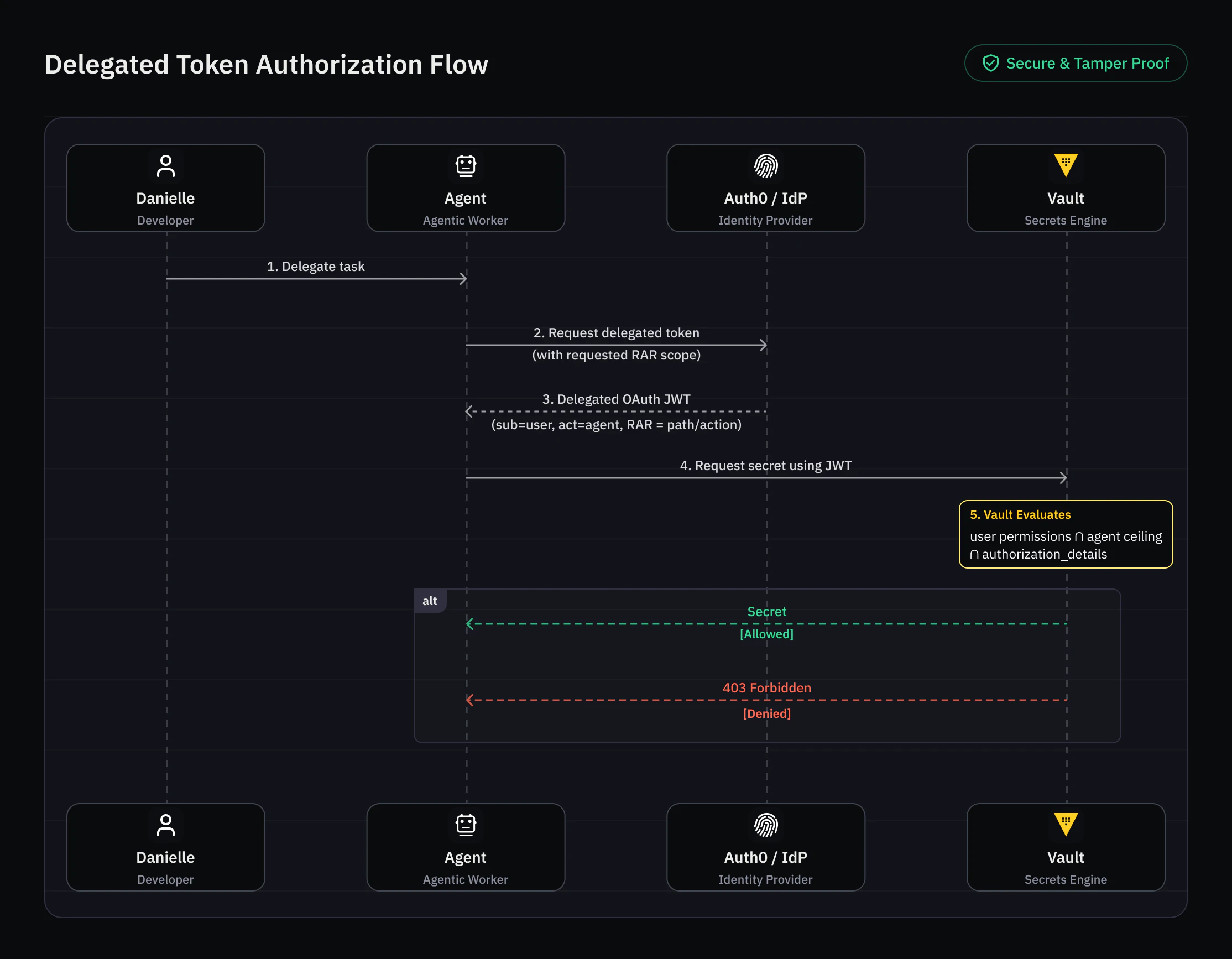
Simplified diagram for secure agent permissions
»Managing agent identity and configuration with the Terraform Vault Provider
Secure authorization is only part of the problem. Teams also need a consistent way to manage agent identities and authentication configuration across environments at scale.
To support infrastructure as code workflows, this GA release adds new resources to the Terraform Vault Provider for managing agent registrations and OAuth resource server configurations declaratively.
The vault_agent_registration resource enables teams to register agents through code, associate them with Vault identities, and apply governance controls consistently across environments. The vault_oauth_resource_server_config_profile resource defines how Vault validates OAuth-issued JWTs, including issuer, audience, signing, and identity validation requirements.
Together, these resources allow teams to manage agent registrations and OAuth validation settings using the same Terraform workflows they already use to manage Vault infrastructure, reducing operational effort for administrators.
»Get started
With this GA release, Vault brings agent identity, authentication, and authorization into a single operational model. By combining explicit registration, request-scoped authorization, support for delegated user workflows, and Terraform-based management, Vault helps teams adopt agentic workloads while limiting broad permissions and maintaining visibility into requests made through Vault. Teams can speed AI adoption at scale when agentic identity access management is supported with centralized governance and auditability. Teams do not have to sacrifice development velocity and can still reduce risk with agentic lifecycle management, delegated workflows, and clear accountability for the governed agentic identities.
Alongside GA, we've expanded Vault's documentation with new how-to guides, deployment patterns, and integration examples. Tutorials for IBM Verify usage with Vault Enterprise Agentic IAM and as with Auth0 are now available. Access these resources to help your teams implement agent registration, OAuth-based authentication, delegated user workflows, and fine-grained authorization in existing environments.