
AI-driven infrastructure is broader than generating configuration. It is a growing set of workflows across the whole lifecycle: application teams composing infrastructure from approved patterns in natural language, platform teams designing modules and generating policy from compliance requirements, provider developers building against API specifications, and the Day 2 operations of drift, version uplifts, and lifecycle management.
What AI changed is where the constraint sits. Code that took days now takes seconds, so the bottleneck has moved from authoring to verification and approval, exactly where HCP Terraform’s enterprise controls live. The platform engineer’s role moves with it: less time writing configuration, more time writing the workflows, specifications, and verification gates that agent output must clear.
AI agents now run the loop a human used to drive; they author Terraform, open changes, and trigger runs without a person stepping through each one. HCP Terraform is the managed control plane that governs those runs. It anchors the agent context going in, gates its output on policy before anything mutates, and provides identity and role-based access control. Agentic workflows do not change the need for these controls; they amplify it. Where teams once relied on learned process, the controls are now mandatory, applied to every run instead of left to judgment. The control plane is only as strong as the boundaries teams configure: approved modules, mandatory policy checks, scoped identities, isolated workspaces or projects, and run history that preserves the evidence.
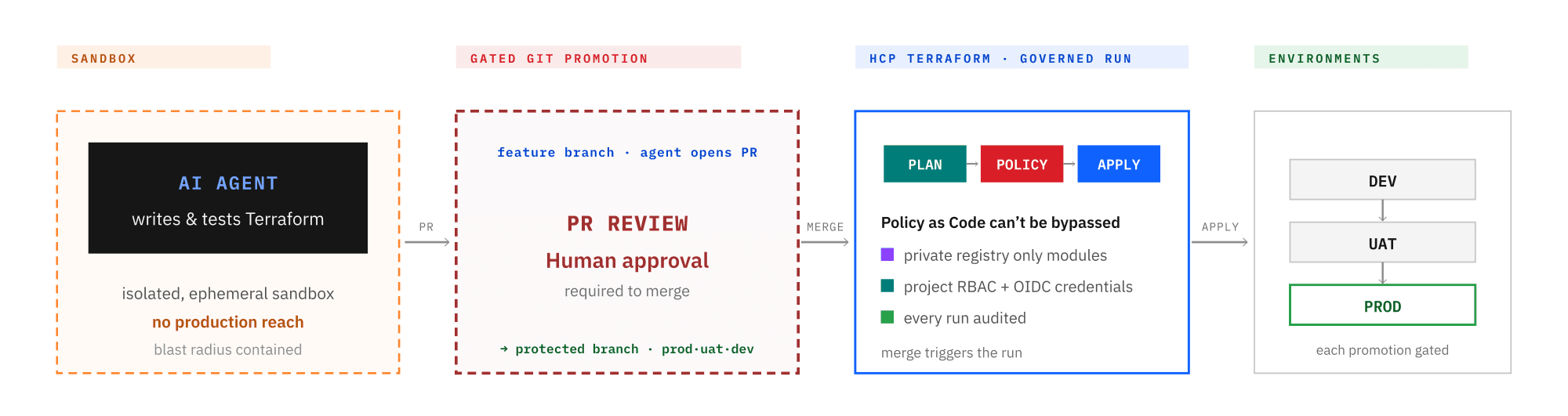
How an agent-authored change reaches production: proposed in a sandbox, promoted by a human-approved merge, governed by HCP Terraform.
In this post we will cover why an autonomous agent breaks the assumptions IaC review was built on, the five layers of defense HCP Terraform puts between agent output and production, how those controls fit together from Git to cloud, and the operating model that lets you grant agents more autonomy over time, not less.
»The risk isn't Terraform: it's automation without guardrails
AI coding agents have moved past autocomplete. They run a loop (plan, execute, observe, reflect, repeat) that can generate configuration, submit a change, read the result, and try again, all at machine speed. That loop was built for a human author working at human speed: review by eyeball, case-by-case policy, trust the author. An autonomous loop breaks every one of those assumptions at once. It never tires, and 3 a.m. means nothing to it. Without guardrails, an AI agent with write access to your infrastructure will amplify every gap in your IaC maturity through hallucinated output, ungated changes, over-broad access, and unbounded blast radius. This doesn’t call for a new category of tooling, or for engineers to babysit every run. The agent just has to enter the same control plane every other author already uses.
Risk | Control layer | What happens |
|---|---|---|
Hallucination | Provenance | Reasoning from generic priors instead of your authoritative sources, the agent invents plausible-but-wrong output. |
Ungated output | Policy | Non-compliant or broken changes move toward production because no independent gate stops them. |
Over-broad access | Identity | The agent inherits standing credentials or wide human permissions it does not need, and secrets leak into the environment. |
Unbounded blast radius | Isolation | With nothing to contain it, one mistaken change cascades far beyond where the task started. |
»Letting the loop run without surrendering control
How do you let an autonomous loop run at machine speed without giving up the controls production already requires? You don’t do it by trusting the agent more. You do it by routing every agent-authored change through the same managed control plane, under the same controls you expect of any other author. The agent can propose. It should not decide.
»Defense in depth: five layers between agent output and production
HCP Terraform keeps the loop governed with layered defense. Each layer is a managed capability of the platform, not a script the agent can skip, and each answers one way an ungoverned loop breaks. Provenance anchors the agent in authoritative context (approved Private Registry modules via the Terraform MCP, agent skills, and your org standards) so it reasons from your sources instead of generic priors. Policy as code and run tasks evaluate every run, with required approval before an apply. A dedicated, project-scoped identity issues dynamic provider credentials per run and revokes them at the end. Projects and workspaces bind state, variables, and permissions to a boundary, so a mistake cannot cross it. And run history preserves plan output, policy decisions, approvals, and apply records as durable evidence. In practice, the five layers expand into 11 complementary controls, from network isolation and secret detection through identity federation and project-scoped RBAC, spanning the agent’s whole path, not just the final apply.
Layer | What it provides | What breaks without it |
|---|---|---|
Provenance | Private Registry modules, agent skills, and your standards anchor the agent in authoritative context. | Without approved modules, agent skills, and standards to anchor it, the agent falls back on generic priors and builds plausible but unvetted infrastructure. |
Policy | Policy as code and run tasks evaluate every run, with required approval before an apply. | Security and compliance are never tested, and the agent’s confidence, not policy, decides what reaches production. |
Identity | A dedicated, project-scoped identity with dynamic provider credentials, issued per run and revoked at the end. | The agent holds broad standing access and long-lived secrets, so one compromise reaches everything. |
Isolation | Projects and workspaces bind state, variables, and permissions to a boundary, so a mistake cannot cross it. | Without a project or workspace boundary, an off-track or misguided agent can impact every project and environment it has access to. |
Audit | Run history preserves plan output, policy decisions, approvals, and apply records as durable evidence. | When something breaks, no one can reconstruct what changed, why it passed, or who approved it. |
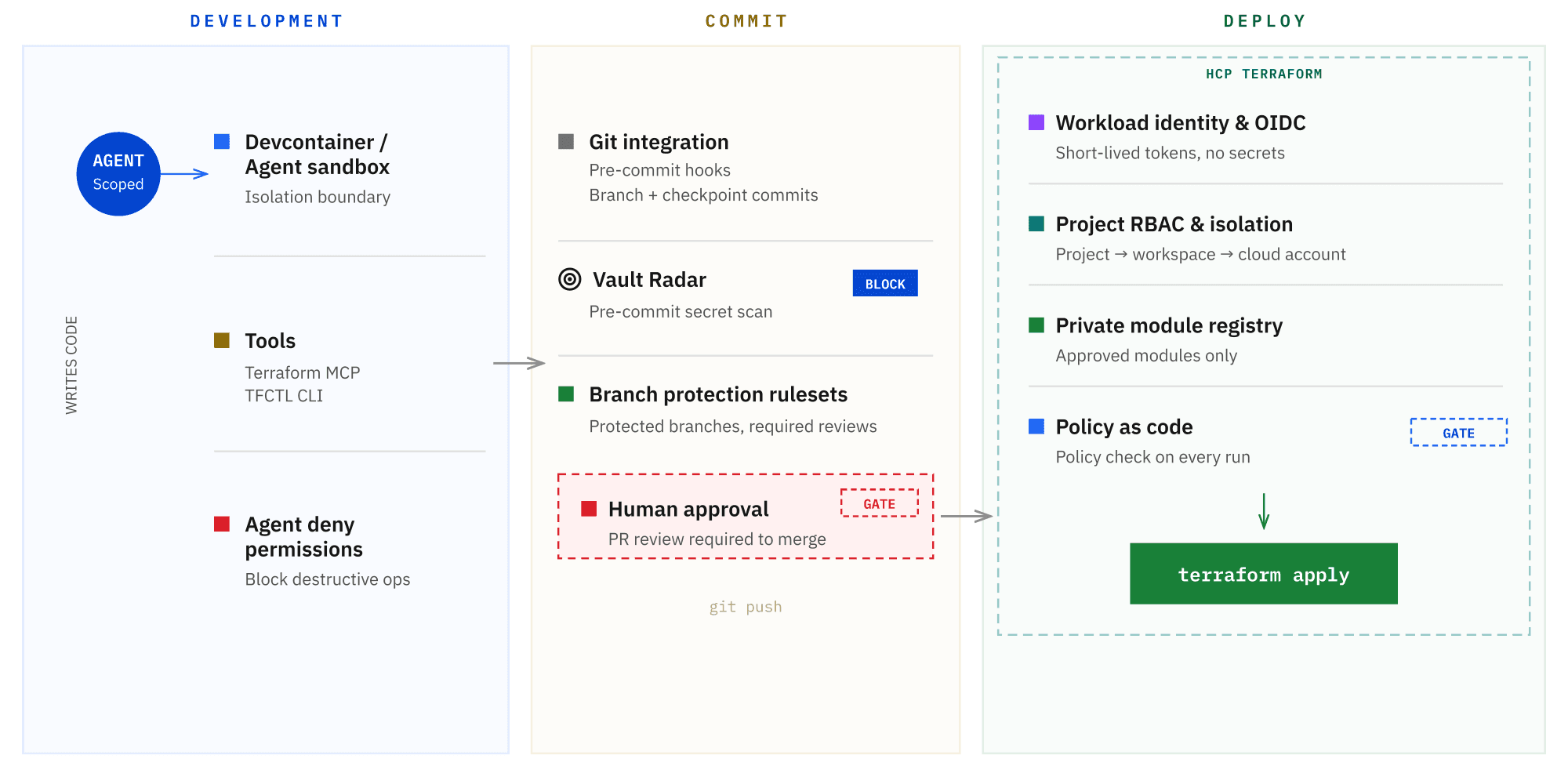
Every agent action passes through layered guardrails (development, commit, deploy) before it reaches infrastructure.
»The control plane turns agent speed into governed throughput
In this operating model, every agent-authored infrastructure change runs through HCP Terraform. A run produces a plan (the proposal), and the apply (the mutation) happens only after the controls clear. The Private Module Registry gives the agent versioned, tested, security-scanned building blocks to compose from, never raw resources, with policy that can enforce registry-only sourcing. Terraform evaluates policy as code between the plan and the apply in two tiers: mandatory policies stop the run on failure, advisory policies warn and proceed. An agent without policy-admin or override permissions cannot bypass mandatory policy enforcement, because the gate lives in the platform layer, not in the agent. The agent acts under its own project-scoped identity with a dedicated team token, dynamic provider credentials revoked per run, and secret detection as a backstop, never a human’s standing access. And when something does get through, architecture caps how far it spreads: One agent maps to one workspace and state, and projects isolate environments and permissions.
Dimension | What it does | Key capabilities |
|---|---|---|
Provenance — Set the context | Authoritative inputs anchor the agent in your sources, standards, and domain knowledge instead of generic priors. | • Private Registry modules via the Terraform MCP • Agent skills supply domain expertise • Clarified requirements and org standards reinforce context |
Policy — Gate every run | Policy as code evaluates what the agent produced, independently of its confidence, before anything mutates. | • Mandatory policies cannot be bypassed • Run tasks attach external compliance checks • Apply approval stays explicit |
Identity — Scope the identity | The agent acts under its own project-scoped identity, not a human’s standing access. | • Project-level RBAC with a dedicated team token • Dynamic provider credentials, revoked per run • Secret detection as a backstop |
Isolation — Contain blast radius | When something gets through, architecture caps how far it spreads. Containment is built into the topology, not a rule that can be skipped. | • One agent maps to one workspace and state • Projects isolate environments and permissions • Sandboxed execution separates the agent from the Terraform execution environment, preventing credential extraction |
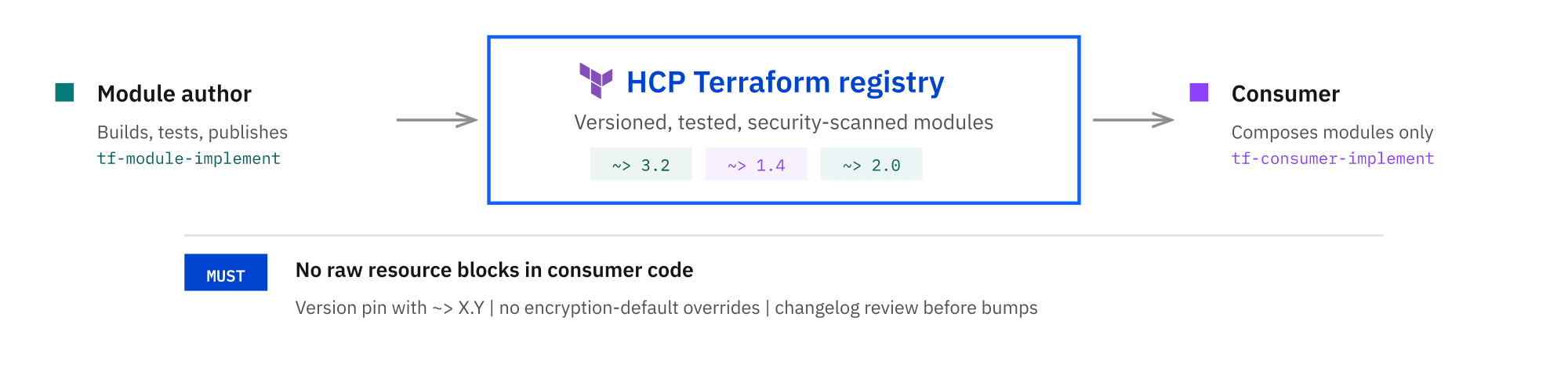
Approved, composable building blocks. Consumers compose from the registry, never raw resources.
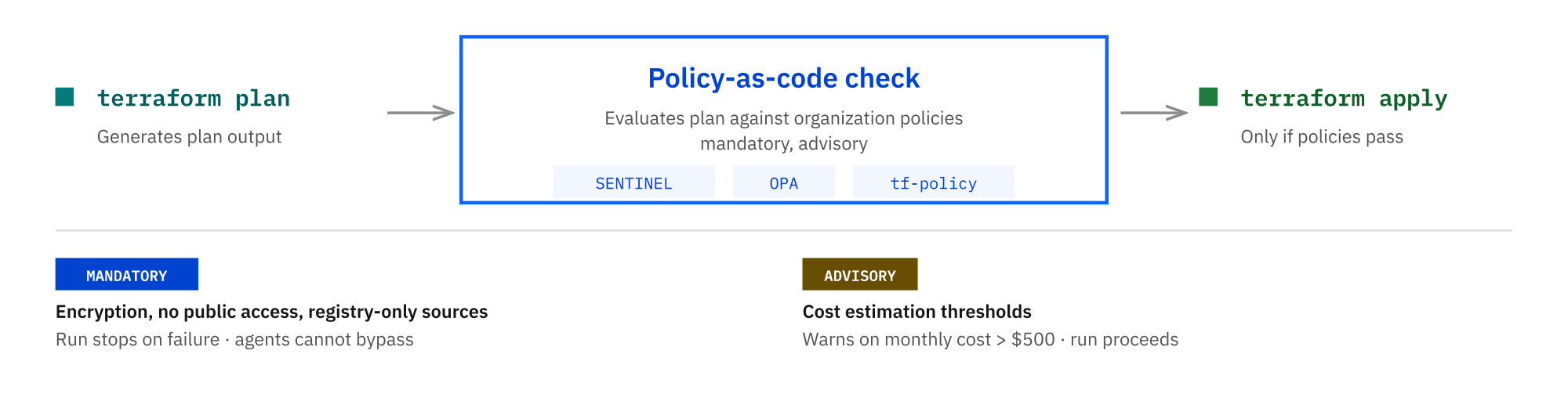
Policy is evaluated between plan and apply. Agents cannot bypass mandatory rules.
»A reference architecture from Git to cloud
Put the controls on one diagram and the operating boundary becomes obvious. The agent commits to feature branches and reaches Terraform through a dedicated, project-scoped team token, never with cloud secrets. Protected branches map to workspaces, and merges trigger runs through a shared pipeline of plan, cost estimation, policy check, and apply. OIDC can confine each run’s cloud access to the account, role, and workspace boundary you configure. Each Terraform project maps to its own cloud sub-account through project-level dynamic credentials, so an agent scoped to one project physically cannot provision in another’s account. The agent operates at the Terraform API layer and never holds cloud secrets: each run exchanges a short-lived token through OIDC federation (AWS AssumeRoleWithWebIdentity, an Azure federated credential, a GCP workload identity pool, or a HCP Vault JWT/OIDC auth method), revoked when the run completes. HCP Vault Radar runs as a pre-commit check so no key, token, or private key ever reaches the repository. Blast radius is bounded by architecture, not just policy, which is what lets you widen an agent’s autonomy as it earns trust.
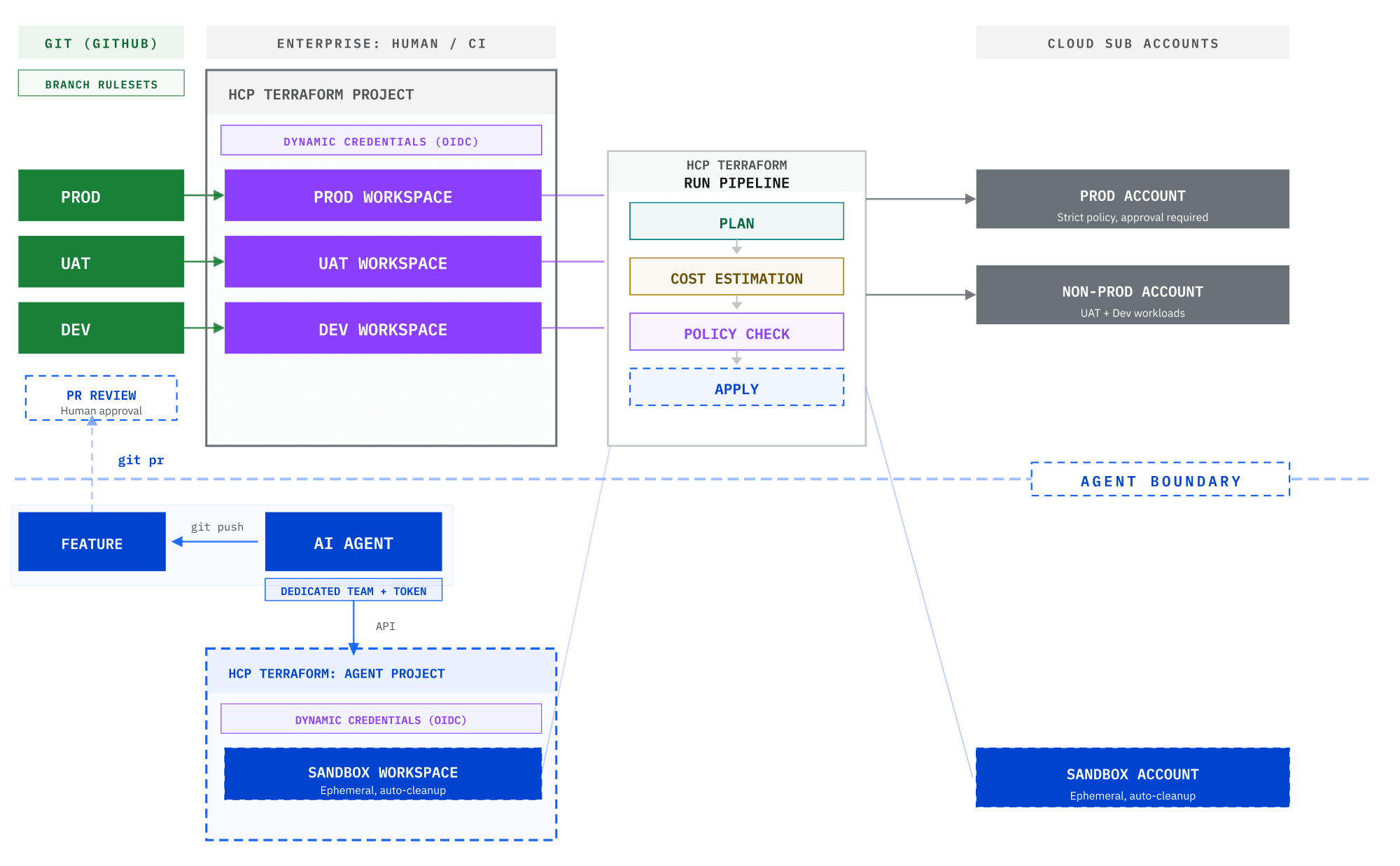
Git → HCP Terraform → run pipeline → cloud account. The agent is scoped to feature branches and a sandbox only.
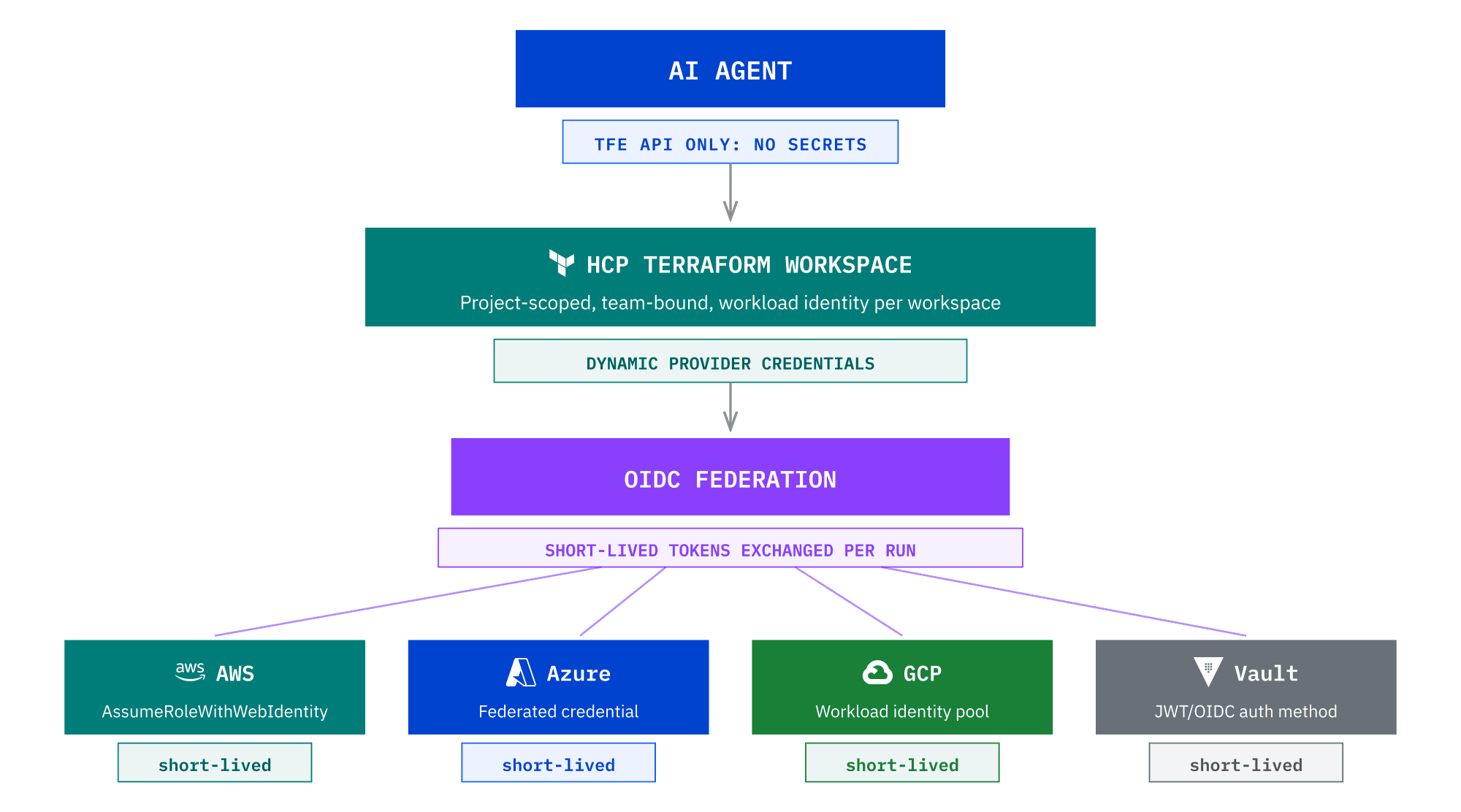
Short-lived tokens exchanged per run. The agent never touches a cloud secret.
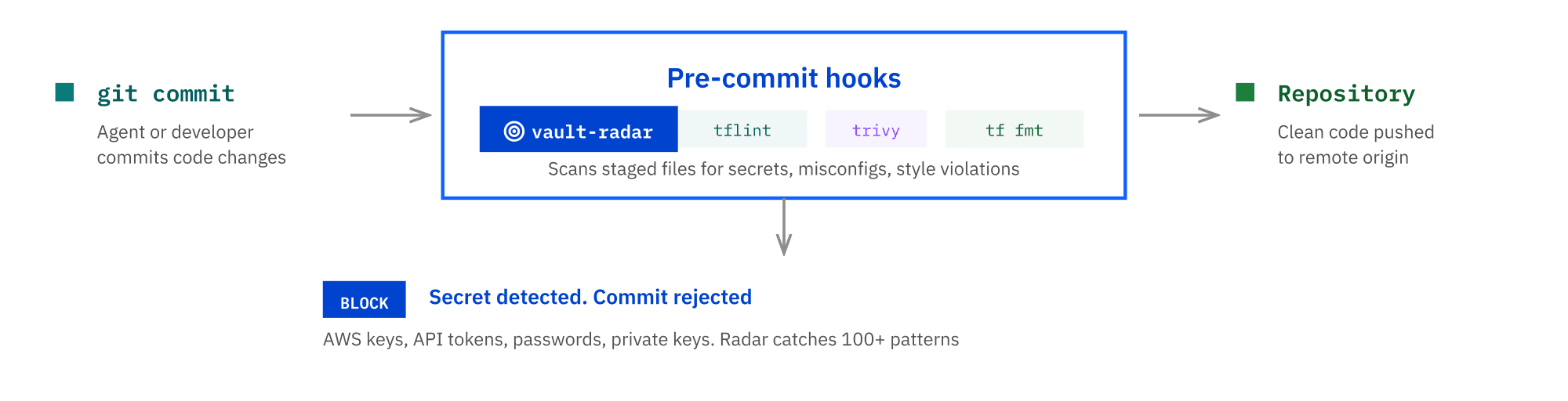
Secrets never reach the repository. Vault Radar can block risky commits or pull requests when configured in the developer, CI, or Git workflow.
»The operating model: agent proposes, Terraform governs
The model shouldn’t be the thing enforcing the rules; it should run inside the system that does. The agent should do useful authoring work: generate Terraform, explain the change, run validation, and summarize results. It should not approve its own change, weaken policy, hold broad credentials, or push production changes outside the governed run. The agent’s own loop of generate, validate, plan, test, and retry makes the work better, but it is not a control: a confident agent can verify itself into a change that is wrong but still passes its own checks. The gate is the platform’s independent verification (policy as code, run tasks, and human approval), not the agent’s self-check. Application teams compose approved modules in natural language; platform teams ship those modules faster; both work inside the same control plane.
Stage | Control | What happens |
|---|---|---|
Before the run | Set the context | The Private Module Registry provides deterministic module sources, agent skills embed organization policy and best practices as domain knowledge, and spec-driven development keeps a human in the loop for verification and collaboration. |
At the boundary | Constrain authority | Scoped identity, project-limited permissions, and dynamic credentials bound what a run can reach. |
During the run | Verify the outcome | Plans, policy as code, run tasks, and test-driven development verify the actual output of every run, turning a confident proposal into a verifiable outcome. |
After the run | Keep evidence | Plan output, policy results, approvals, and run history stay attached to the workspace. |
» The same control plane, a different win for each team
The payoff lands differently for each team. Platform teams ship golden modules in hours instead of sprints, so consuming teams stop waiting on them. Application teams self-serve infrastructure from approved modules in natural language, compliant by construction rather than by after-the-fact review. Provider developers get a shorter path from API spec to released provider, and their test coverage climbs. Security teams turn compliance baselines into policy as code without deep coding expertise and see it enforced on every run. Operations teams cut the manual toil of drift, upgrades, and lifecycle work that usually slips through the cracks. What they share is a single governed way of working.
Team | Role | Outcome | Impact | Use cases |
|---|---|---|---|---|
Platform team | Producer | Ship golden modules faster | Compliant, tested modules delivered in hours, not sprints, and consuming teams stop waiting on the platform | • Author and test private registry modules • Generate policy from requirements • Uplift modules across provider changes |
Application team | Consumer | Self-service, safely | Infrastructure self-served without a platform ticket, compliant by construction instead of by review | • Compose approved modules to a spec • Stay aligned to policy automatically • Uplift module versions on Day 2 |
Provider developers | Ecosystem | Accelerate provider design and development | A shorter path from API spec to released provider, with test coverage that climbs instead of regressing | • Test-driven development • SDKv2 → plugin framework • Raise test coverage |
Security team | Policy as code | Codify guardrails as policy | Guardrails enforced on every run rather than sampled in review, with no policy-authoring bottleneck | • Generate policy from compliance baselines • Test policies before they gate runs • Remove the policy-authoring bottleneck |
Operations | Day 2 | Keep infrastructure current | Drift caught before it compounds and upgrades kept routine instead of becoming firefights | • Detect and remediate drift • Run module and provider upgrades • Manage the lifecycle end to end |
»Getting started: Don’t give AI a path around the controls
Think: Agents open the change; they do not change the shape of governance.
Feel: Confident that adopting agentic IaC does not mean surrendering control.
Do: Route every agent-authored change through Terraform, with the same controls you expect of any human author.
To get started, source modules from the Private Module Registry; make policy mandatory on every run; create a dedicated, scoped identity with project-level RBAC and dynamic credentials; map the agent to a dedicated team and isolated project; and treat run history as the evidence layer. Relevant resources include: