Enterprises rely on HashiCorp Vault to secure access to sensitive systems, applications, and data across increasingly complex hybrid and multi-cloud environments. But the environment around those applications is changing. Machine identities continue to grow, certificate lifecycles are becoming shorter, cryptographic requirements are evolving, and AI agents are creating a new class of autonomous workload that must be identified, authorized, and governed.
Today, we are announcing the public preview of Vault Arc, expanding the Vault portfolio with new capabilities designed for these emerging security and operational requirements.
Vault Arc is still Vault. It builds on the role Vault plays in enterprise security while introducing a new approach to how security resources are modeled, governed, queried, and operated. Importantly, Vault Arc complements Vault Enterprise rather than requiring customers to replace it. Organizations can continue deploying and expanding Vault Enterprise for existing and new workloads while evaluating Vault Arc where its capabilities provide additional value.
»Extending Vault for what's next
Modernization isn't simply about replacing existing technology. It's about giving organizations the flexibility to respond as their infrastructure, workloads, and security requirements change.
Vault Arc introduces a resource-based approach to Security Lifecycle Management. Security resources can be represented with unique resource identities designed to make them easier to understand, query, govern, and incorporate into security policy.
This approach provides a foundation for several important capabilities:
More intuitive authorization and governance. Vault Arc separates access grants from broader governance policies, helping organizations establish enterprise guardrails while allowing teams to manage appropriate access within those boundaries.
Greater visibility and auditability. Typed, queryable resources make it easier for security and platform teams to understand what exists in their environment and answer questions about credentials and other security resources.
Simplified operations and developer workflows. Vault Arc is designed to reduce operational complexity while making common workflows easier to consume through APIs, automation, and streamlined user experiences.
Cryptographic agility. As cryptographic standards evolve, Vault Arc provides a foundation for more policy-driven approaches to managing keys, certificates, algorithms, and future cryptographic transitions.
»Preparing for machine and agentic workloads
The growth of non-human identities is changing what enterprises need from identity and secrets management. AI agents accelerate that change. Agents can perform different tasks, interact with multiple tools and systems, and take actions on behalf of people and applications. The authority an agent requires can therefore depend on its identity, current task, context, and mandate. Treating these agents simply as another long-lived service account risks losing that context.
Vault Arc is being designed with these emerging workloads in mind. The public preview establishes capabilities for agent identity governance, scoped and ephemeral authorization, and auditable agent activity. Organizations can begin moving toward a model in which agent access is tied more closely to identity, policy, and the work being performed.
This represents an important step toward Agentic Security Lifecycle Management (SLM), where organizations can govern what an agent represents, what it is authorized to do, what credentials and resources it can access, and what actions it performs throughout its lifecycle.
»Modernization without a forced migration
Vault Enterprise and Vault Arc are designed to coexist, giving organizations the flexibility to determine where each best meets their requirements. Customers can continue deploying Vault Enterprise while evaluating and adopting Vault Arc incrementally based on individual applications, workloads, and use cases.
This approach allows modernization to happen at the pace of the enterprise rather than according to an arbitrary migration deadline. Organizations can progressively evaluate and introduce new capabilities while reducing the disruption and risk traditionally associated with major platform transitions.
»Extending governance across Vault
As organizations expand their Vault footprint, they also need greater visibility and governance across an increasingly distributed security estate.
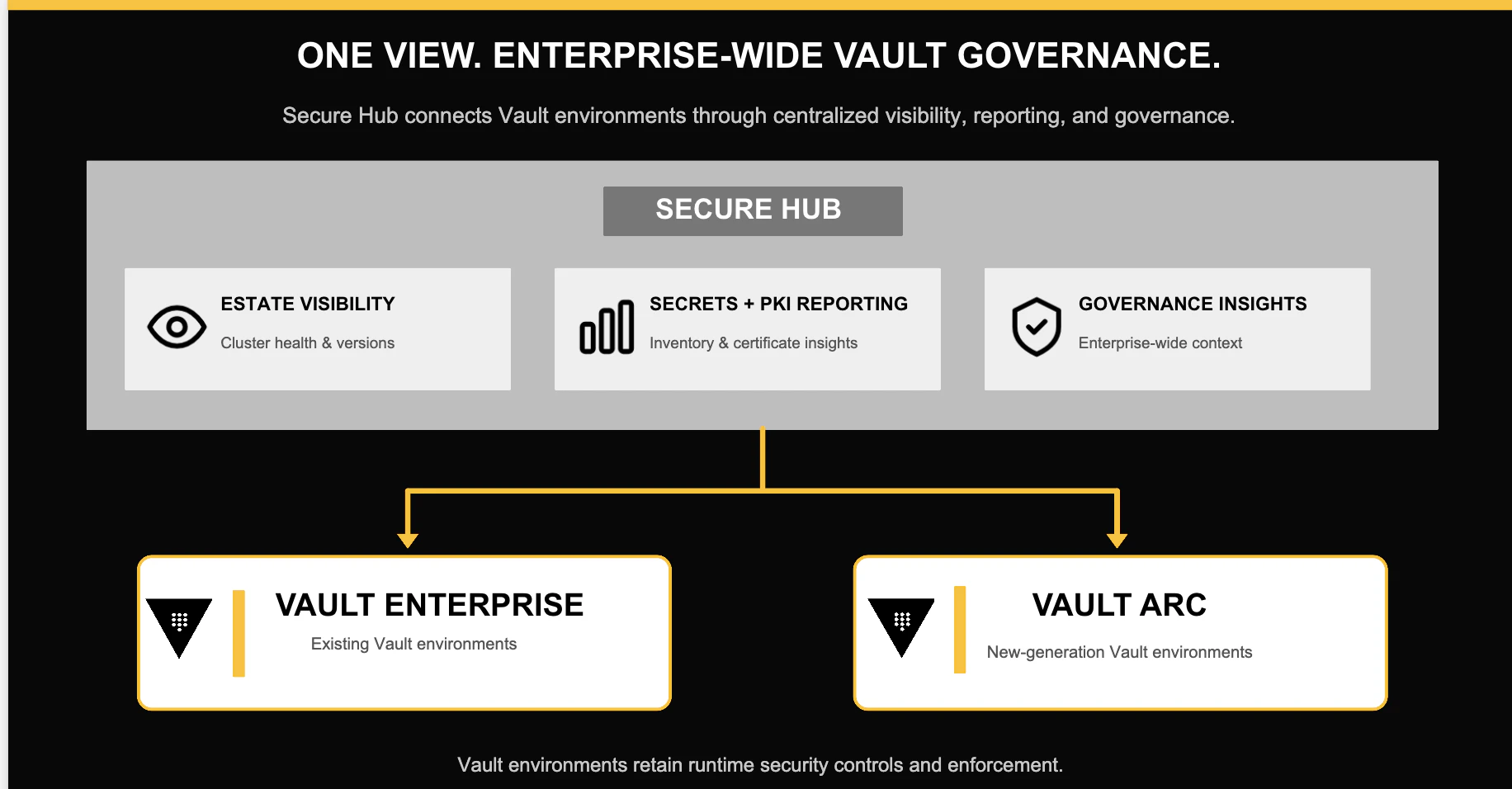
Secure Hub, also entering public preview, complements this strategy by providing centralized visibility, reporting, and governance across Vault environments, including Vault Enterprise and Vault Arc. This gives organizations greater enterprise-wide context while controls and enforcement remain within individual Vault environments.
Together, Vault Arc and Secure Hub provide organizations with greater flexibility to introduce new capabilities while developing a more consistent governance model across their broader Vault estate.
»Expanding security lifecycle management
Together with Vault Enterprise, Secure Hub, and capabilities across the broader IBM security portfolio, Vault Arc advances a Security Lifecycle Management strategy designed for environments in which humans, applications, machines, and increasingly autonomous agents all require secure access to enterprise resources.
The public preview gives customers an opportunity to experience that direction firsthand and provide feedback that helps shape the evolution of Vault Arc.
Join the HashiCorp Vault Arc public preview to explore the new capabilities, share your feedback, and evaluate how Secure Hub can extend your organization's Security Lifecycle Management strategy.
Learn more about the SLM announcements at TechXchange.